
5170 Sundial Crt. Mississauga ON L5R 2S9, Canada

Advanced Rubber Hose Manufacturing Technologies: Processes and Innovations

1 The Evolution of Rubber Hose Production

Rubber hose manufacturing has undergone a remarkable transformation from a labor-intensive craft to a highly sophisticated, technology-driven process. Modern industrial operations demand hoses that can withstand extreme pressures, temperatures, and environmental conditions, driving continuous innovation in manufacturing techniques. The global industrial hose market continues to expand steadily, with particular growth in specialized segments like abrasion-resistant slurry hoses and high-performance air/water transfer hoses .
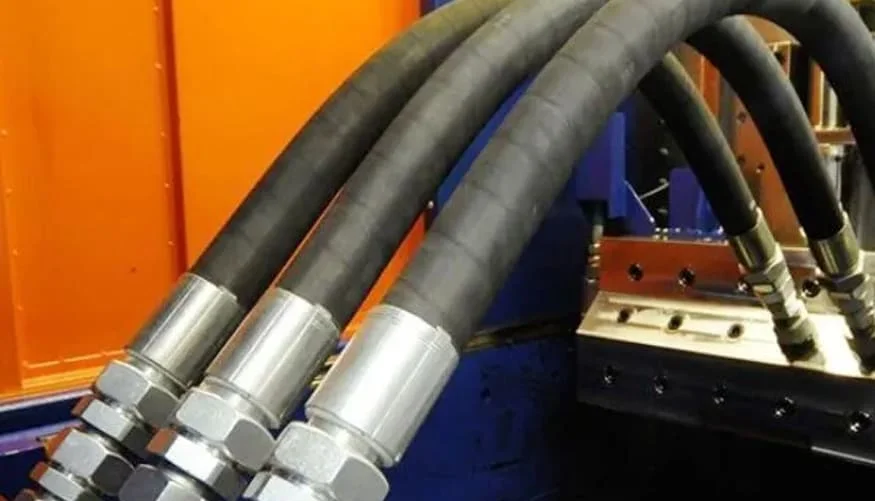
The fundamental structure of a rubber hose consists of three key components: an inner tube​ that contains the conveyed medium while resisting wear and erosion, a reinforcement layer​ that provides structural strength and pressure containment, and an outer cover​ that protects against external damage and environmental factors . This multi-layer approach allows engineers to tailor hose properties to specific application requirements, from high-pressure hydraulic systems to chemical transfer applications .
Advanced manufacturing has shifted toward highly continuous and automated production​ methods that ensure consistent quality while reducing production costs. Modern facilities utilize computer-controlled machinery for precise compounding and extrusion, along with automated quality control systems that maintain strict tolerances . This technological evolution has enabled manufacturers to produce hoses with enhanced durability, flexibility, and specialized properties to meet increasingly demanding industrial applications .

2 Material Selection and Compound Preparation

The manufacturing process begins with careful material selection, where engineers choose base polymers and additives based on the hose’s intended service conditions. Common rubber materials include EPDM​ for excellent ozone and weather resistance, nitrile rubber​ for oil and fuel resistance, and SBR​ for general-purpose applications . For specialized applications, manufacturers may select fluoroelastomers​ for extreme temperature and chemical resistance or silicone rubber​ for food-grade and medical applications .
The compounding process​ involves precisely mixing the base rubber with various additives to enhance specific properties. Key additives include reinforcing fillers like carbon black​ for strength and abrasion resistance, vulcanizing agents​ (typically sulfur-based compounds) to enable cross-linking, accelerators​ to control curing rates, antioxidants​ and antiozonants​ to prevent degradation, and plasticizers​ to improve flexibility and processability . This precise formulation science determines critical performance characteristics such as temperature resistance, flexibility, and service life .
Modern mixing operations utilize sophisticated equipment like internal mixers​ that create intense shear forces to ensure homogeneous dispersion of additives within the rubber matrix . Following the initial mixing, the compound may undergo additional refining on open mills​ (two-roll mills) where operators can adjust roller spacing to control compound thickness and remove entrapped air . The resulting compound is then typically shaped into strips or pellets for efficient feeding into downstream extrusion equipment .

3 Extrusion Technologies for Hose Production

Extrusion represents the core process for forming the tubular structures of rubber hoses. The basic extrusion system consists of a heated cylinder​ containing a rotating screw that conveys, heats, and homogenizes the rubber compound before forcing it through a shaping die​ . Modern extruders offer precise control over temperature profiles and screw speeds, critical for maintaining consistent dimensions and properties throughout production runs .
There are several extrusion variants employed in hose manufacturing:
  • Hot extrusion, the most common method, involves heating rubber until it becomes soft and moldable, then vulcanizing it after extrusion .
  • Co-extrusion​ allows simultaneous extrusion of multiple rubber layers through a single die, enabling combinations of materials with different properties .
  • Reinforced extrusion​ incorporates textile or metal reinforcements during the extrusion process, essential for high-pressure hoses .
The extrusion process begins with feeding the compounded rubber into the extruder’s feed hopper. As the material advances through the barrel, it undergoes gradual heating and mechanical working by the screw, becoming a homogeneous, plasticized mass . This material is then forced through a die​ that shapes it into a continuous tube with specific inner and outer diameter dimensions . For multi-layer hoses, manufacturers may employ sequential extrusion​ processes where the initial tube receives reinforcement layers before applying subsequent rubber layers .
Advanced extrusion lines incorporate laser measurement systems​ that continuously monitor hose dimensions and provide real-time feedback for process control . After extrusion, the hose enters cooling tanks​ where controlled cooling solidifies the shape before further processing . Modern extrusion capabilities allow manufacturers to produce hoses with complex cross-sectional geometries and tightly controlled wall thicknesses, meeting precise performance specifications .

4 Reinforcement Methods for Enhanced Performance

Reinforcement is critical for hoses destined for medium- to high-pressure applications, providing the necessary strength to contain operating pressures while maintaining flexibility. The reinforcement layer is typically embedded between the inner tube and outer cover, consisting of high-strength materials applied in specific patterns to optimize performance .
Common reinforcement approaches include:
  • Braiding, where yarns or wires are interwoven in a crisscross pattern around the hose using braiding machines​ .
  • Spiral winding, which applies reinforcement in a helical pattern, offering superior resistance to expansion under pressure .
  • Knitting, creating a looser structure that provides good flexibility with moderate pressure resistance .
  • Textile wrapping, where reinforcement sheets are wrapped around the hose .
The choice of reinforcement material depends on application requirements: polyester​ and nylon​ yarns for medium-pressure applications, high-tensile steel wires​ for high-pressure hydraulic hoses, and aramid fibers​ for high-strength, lightweight applications . The reinforcement pattern and angle significantly influence hose flexibility and minimum bend radius, with optimal braiding angles typically between 54-56° for balanced strength and flexibility .
Modern reinforcement applications utilize computer-controlled machinery​ that ensures precise tension control and application angles . For critical applications, manufacturers may employ multiple reinforcement layers​ with opposing orientations to balance torque response and improve pressure containment . The reinforcement process must maintain proper adhesion between layers, often achieved through specialized bonding compounds or texturing techniques that create mechanical interlock between rubber and reinforcement materials .

5 Vulcanization Processes and Systems

Vulcanization represents the most critical chemical process in hose manufacturing, where rubber molecules form cross-links under heat and pressure, transforming the plastic material into an elastic product with improved mechanical properties . This process typically uses sulfur-based systems, though peroxides or other curing agents may be employed for specific polymer types .
Modern vulcanization methods include:
  • Continuous vulcanization​ using salt baths​ or fluidized beds​ for constant cross-linking of extruded hoses .
  • Autoclave vulcanization, where hose lengths are wound on drums and placed in large pressurized vessels for batch processing .
  • Microwave vulcanization​ systems that use microwave energy to rapidly heat the hose from within, significantly reducing curing times .
  • Lead vulcanization, where the hose is covered with a lead sheath that is stripped after curing .
The vulcanization process must be precisely controlled regarding three key parameters: temperature, time, and pressure. Inadequate control can lead to under-cure (incomplete cross-linking resulting in poor physical properties) or over-cure (excessive cross-linking causing brittleness) . Modern systems employ computer-controlled curing​ that monitors and adjusts parameters throughout the cycle to ensure consistent results .
After vulcanization, hoses may undergo post-curing treatments​ to stabilize properties and remove any volatile by-products . Some manufacturers are adopting continuous vulcanization systems​ that integrate directly with extrusion lines, allowing uninterrupted production from raw material to finished hose . This approach significantly reduces manufacturing time while improving consistency throughout the hose length .

6 Quality Control and Testing Protocols

Rigorous quality control is maintained throughout the manufacturing process, beginning with incoming material inspection​ to verify compound properties before production . During manufacturing, technicians conduct dimensional checks​ using precision instruments like calipers and lasers to ensure adherence to specifications .
Critical testing protocols include:
  • Hydrostatic pressure testing, where hoses are subjected to pressures significantly exceeding rated working pressure to verify structural integrity .
  • Burst pressure testing​ that determines the ultimate failure point, with quality hoses typically having a safety factor of 3:1 or 4:1 between burst pressure and working pressure .
  • Adhesion testing​ to measure bond strength between different layers .
  • Flexibility and bend radius testing​ to ensure the hose can operate within specified bending limits without kinking .
Specialized tests address specific application requirements: abrasion resistance testing​ using standardized methods for slurry hoses , vacuum testing​ for suction applications , environmental testing​ exposing hoses to ozone, UV radiation, and temperature extremes , and material compatibility testing​ ensuring resistance to various media .
Modern facilities implement statistical process control​ methods that monitor production data to identify trends and prevent deviations before they result in non-conforming product . Additionally, many manufacturers maintain traceability systems​ that allow tracking of materials and processes for each hose batch, essential for critical applications . These comprehensive quality assurance protocols ensure that modern rubber hoses deliver reliable performance under demanding conditions .

7 Advanced Manufacturing Innovations

The rubber hose industry continues to evolve with several significant technological advancements enhancing manufacturing capabilities and product performance. Automation and digitalization​ have transformed production facilities, with computer-controlled systems now managing material feeding, processing parameters, and quality checks .
Emerging innovations include:
  • Smart hose technologies​ featuring integrated sensors for pressure, temperature, and wear monitoring .
  • Advanced polymer compounds​ including nanocomposites that offer enhanced barrier properties and durability .
  • Sustainable manufacturing initiatives​ focusing on energy-efficient processes, recycled materials, and biodegradable formulations .
  • Additive manufacturing applications​ for producing custom fittings and complex hose assemblies .
Modern production lines achieve high levels of integration, with extruders, braiding machines, vulcanization systems, and cutting equipment​ linked in continuous sequences . This integration reduces handling and minimizes production time while improving consistency . Additionally, modular production systems​ allow manufacturers to quickly changeover between different hose types, supporting the trend toward smaller batch sizes and customized solutions .
The future of hose manufacturing will likely see increased adoption of predictive maintenance technologies​ using IoT connectivity to monitor equipment health , advanced simulation tools​ that optimize die designs and process parameters before physical production , and sustainable material developments​ including bio-based rubbers and recycling technologies that support circular economy principles . These innovations will continue to enhance hose performance while reducing environmental impact .
The advanced manufacturing processes employed in modern rubber hose production represent a sophisticated integration of materials science, mechanical engineering, and process control technologies. As industrial applications become more demanding, hose manufacturers continue to innovate, developing increasingly specialized products with enhanced durability, precision, and functionality . This ongoing innovation ensures that rubber hoses will continue to meet the evolving challenges of fluid transfer across diverse industrial sectors .

Share the Post:

Related Posts

Join Our Newsletter

Scroll to Top